If discussed at all today, Ludwig Hilberseimer's late European and American work is identified as a precursor of contemporary ecological approaches to the city. Scott Colman suggests that his theory of architecture and his approach to design have broader implications – not because Hilberseimer was free of modernist problematics, but because he squarely confronted them.
ReadPeter O’Grady reviews 'Absolute Wasters', a panel discussion between Tanad Aaron, Ciarán Cuffe, Jane Larmour, Ste Murray and Orla O’Kane. The discussion was chaired by Professor Hugh Campbell and organised by UCD student curators. The event was held on Friday May 22nd as part of the opening night of 'Outside In', the UCD School of Architecture, Planning and Environmental Policy’s annual end-of-year exhibition.
ReadCreativity has long been the human capacity we considered beyond the reach of any machine. Most can agree that Artificial Intelligence (AI) has crossed the threshold of being on the periphery to our work and is now embedding itself into our thinking, our workflows, and our society. As these shifts begin influencing the creative industries, we have to ask: what truly changes, and is creativity still what makes us human?
ReadIn this article, Ciara O’Connell closes our mini-series ‘Drafting Identity’ which focuses on the experience of women in Architectural Education from both personal and professional perspectives, supporting the FIAE movement. Ciara explores the pressures a career in architecture places on life outside of work, and the significant material impacts that places on women, in particular.
ReadAll journals and books are free to download for Type members; please login or use the download button for access.
Non-members can purchase items from the library on a one-off basis or become a member of Type to avail of the full benefits of membership.

2ha #12 considers the power of local, national, and international governance in determining suburban morphology. Three essays focus on the multiple means by which bureaucratic structures and political ideologies control the ways, rules, and regulations in which suburban development takes place.

Beginning in 1972, the RIAI Bulletin was a monthly newsletter to inform Institute members of the wide range of matters with which the RIAI was involved.

This paper reports on a study investigating aspects of housing estates related to the pedestrian precinct or residential yard concept.

Beginning in 1972, the RIAI Bulletin was a monthly newsletter to inform Institute members of the wide range of matters with which the RIAI was involved.

2ha #04 explores the relationship between history and suburban development. Three essays respond to the changing processes by which suburbia has been bought, built, and sold.

Beginning in 1972, the RIAI Bulletin was a monthly newsletter to inform Institute members of the wide range of matters with which the RIAI was involved.

First published in 1978, Architecture in Ireland was a magazine which featured ‘news, views and reviews’, architecturally significant buildings, and descriptions and illustrations of proposed developments.
Read more
Beginning in 1972, the RIAI Bulletin was a monthly newsletter to inform Institute members of the wide range of matters with which the RIAI was involved.
Read more
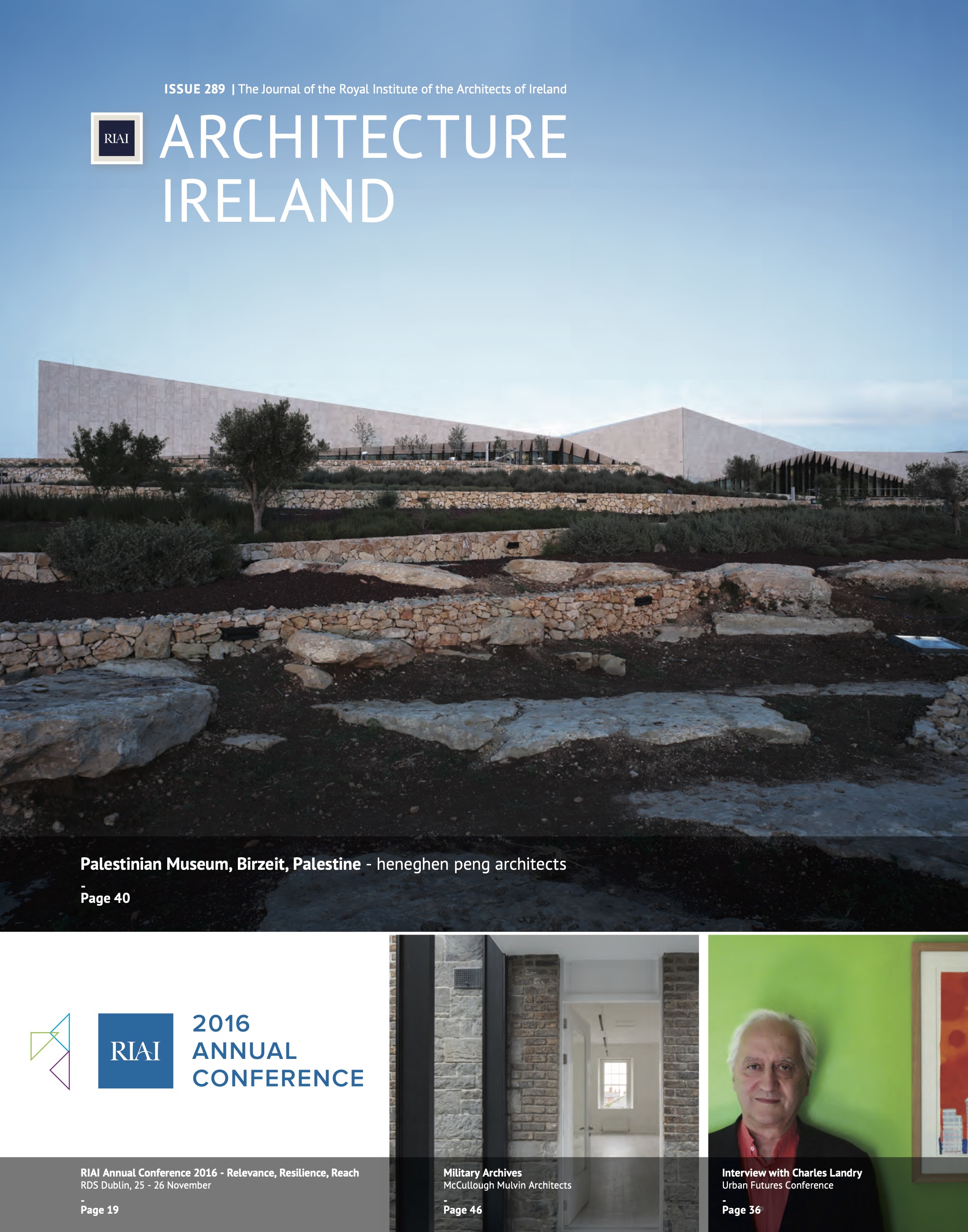
Architecture Ireland is the journal of the Royal Institute of the Architects of Ireland. Issue #293 focuses on the theme of 'designing Ireland's commercial infrastructure'.
Read more
Beginning in 1972, the RIAI Bulletin was a monthly newsletter to inform Institute members of the wide range of matters with which the RIAI was involved.
Read more
Beginning in 1972, the RIAI Bulletin was a monthly newsletter to inform Institute members of the wide range of matters with which the RIAI was involved.
Read more
Empirical is an annual architectural research journal by TU Dublin architectural technology students exploring environmental design, digitalisation, materials, and building performance.
Read more
This paper explains the nature of dimensional deviation in prefabricated elements and that the development of designs should include a clear approach to accommodate or control deviations when they do occur.
Read more
The first of the two volumes, The Dublin Region: Advisory Plan and Final Report (Part I) examines the social, economic and physical resources of county Dublin and its environs with a view to guide the use of land and public and private building works for the following thirty years.
Read more
This paper documents the proceedings of a colloquy on Ireland in the Year 2000, held in Kilkea Castle in February 1980.
Read more
This book investigates the global architecture of commodities. It does so by examining the spaces of production and transportation of seven specific items, chosen for their ubiquity within everyday life. In doing so, we not only realise how a washing machine can relate to a banana, but also how, as architects, we might begin to design alternatives.
Read more
Mapped is the outcome of a Dublin School of Architecture research project interested in the origins and morphology of Irish villages. The book is intended as a guide to planned villages; those distinctly formed by the actions of landlords, religious groups, and entrepreneurs.
Read more
This publication documents a 1983 colloquium concerned with the need for an Irish national strategic plan to provide the physical, economic, and social infrastructure required by the end of the 20th century.
Read moreType involves a collective of writers, researchers, and editors with expertise in architecture, landscape architecture, urban design, and planning.
We’re interested in working with individuals and organisations to gather, format, and disseminate knowledge on the built environment.
Have a potential project in mind? We are always open to new ideas and the possibility for collaboration. Please use the form provided to get in touch.

Website by Good as Gold.