
Membership of Type allows unlimited access to our online library. Join to support new research and writing on the design of the built environment.
You can read more about membership here.
Already a member? Login to your account to avail of unlimited downloads.

Membership of Type allows unlimited access to our online library.
Join to support new research and writing on the design of the built environment.
You can read more about membership here.
Individual Membership Fees
Individual membership is available on a monthly or annual basis.
The fee is €10/month or €99/year.

Despite the dreary Dublin evening of now seemingly perennial rainfall, the Robert Emmet Theatre was filled to hear Neil Michels, Associate Director of Carmody Groarke, deliver a lecture entitled Value Judgements as part of the Architectural Association of Ireland’s ‘Systems and Selves – Social Agency of Architecture’ series. The series is composed of interdisciplinary talks exploring the qualitative significance of design in the public domain within the contemporary built environment. Now in their twentieth year, London-based Carmody Groarke have established themselves as one of the pre-eminent contemporary architecture practices. From their earliest work comprising impromptu and temporary installations – including collaborations with artists such as Anthony Gormley – to more recent, large-scale public projects, Carmody Groarke have developed a unique and tangible visual ethos of making buildings. Theirs is a language where formal speculation and meaning is found in the conciliation between invention and tradition; in the sympathetic relationship of materials and the understanding by which hands and tools put them together; and an honest engagement with place and purpose. The work of the practice is often epitomised by an attitude of ‘doing the most with the least’ [1], utilising overlooked materials and unorthodox construction methods to yield unexpected solutions.
Michels began by outlining the practice’s early work via the unbridled vigour and initial sensibilities exhibited in their 2008 atectonic private underground swimming pool in Limerick, before transitioning to an onscreen image of the recently completed preservation of Manchester’s Museum of Science and Industry. ‘Value judgements,’ he stated, ‘comprise the constant decisions architects make daily and over long periods of time in creating their work.’ The metric or means of this ‘value’ often varies, as illustrated in the two projects shown. The former centred on the removal of context and the formation of space through a composition of the finest materials from around the word. A very different approach was taken on the latter, listed, public building, where judgments of heritage, context, and decarbonisation became key measures of the process.
The body of Michels’s lecture expanded upon this idea of value judgments as drivers across three recent large-scale, cultural works. Each featured cultural institution was at a moment of evolution or growth. The resulting projects adopted distinct empathetic reactions to issues of contextual intervention; public access and appropriateness; climactic response; decay; and availability of local material, while questioning sourcing and established material manufacturing processes. This process he described as 'an arc of judgements’.

The first of the presented projects was for Dulwich Picture Gallery in South London, the world’s first purpose-built public art gallery. Interested in how a historic institution engages a modern audience and responds to the contemporary visitor’s needs, the gallery approached Carmody Groarke to design a children’s art gallery, update their considerable grounds, and gently renovate the existing John Soane-designed museum. Initially conceived as a space to protect the housed works as well as a mausoleum for the museum’s founders, the building’s defensive nature and heaviness needed to be broken down to make the gallery more inviting and open to the public. Carmody Groarke’s first move was to reconsider the approach and arrival to the site and existing galleries. The entrance was reoriented, making the gallery visible on approach to the public entrance. An additional southern entrance was enlarged, and an existing small cottage on site renovated into a public café which activates the space around it. However, it is primarily the creation of a new children’s art play pavilion, centrally located and visible on all sides in the newly opened parkland, which has gifted a publicly accessible and inviting garden meadow to a new demographic of people in London.
While the intervention at Dulwich was centred around public use and activation, the brief for the Ghent Design Museum, as described by Michels, was that of sympathetically stitching a contemporary building onto a tight site within Ghent’s historic core. While the medieval-inspired building form, varied programmatic function, and contextual sensitivity are of note, it is the extensive material research and innovative construction of this project which most clearly demonstrate the conscious value judgements of the architects and the broader design team. Historically a city of timber structures clad in masonry skins, Carmody Groarke set themselves the task of developing for Ghent 'a new sustainable vernacular, coupling less environmentally onerous materials with more forgiving detailing’ [2]. As with most construction materials and their manufacturing processes, brick production, previously geographically and aesthetically linked to place, has become ‘mechanised' and its procurement 'increasingly globalised’ through time. A multi-year research project involving a team of architects, material specialists, lawyers, and regulators resulted in the development of a low-carbon brick for use on the Ghent Design Museum’s new wing. The resulting Ghent Waste Brick is made from 63% recycled local municipal waste, with hydraulic lime acting as the primary binding agent. Most notably, unlike conventional bricks, Ghent’s are cured and compressed rather than fired, a process which, combined with the use of recycled composites, results in a brick that the architects report to have just one-third the embodied carbon of a typical Belgian clay brick. The recycled waste product was sourced within 7km of the project site and manufactured on a brownfield site on the city’s outskirts, re-establishing the possibility of what Carmody Groarke term ‘hyper-localised construction’. Crucially, as the principle of production is not contingent on a particular mix or recipe, this technique could easily be replicated in other urban settings.

The third and final project Michels presented was a new storage repository for the British Library’s ever-growing print collection. Occupying a 44-acre campus, the collection houses over 170 million items. In the last ten years, around seven million physical items have been added to the library’s archives, requiring approximately 8km of new shelving annually [3]. The project was for a new, fully automated storage repository to provide approximately 225 linear kms of additional capacity. Carmody Groarke’s goal was to create a modern, high-performance, airtight envelope to house the automated storage systems and passively climate-control the high-use space, thus lowering the massive amount of energy ordinarily required to operate such spaces. Their primary departure from default thinking was to challenge the assumption that a mechanical ventilation system is the easiest route to climatic control. Instead, they conceived of a building which has no traditional heating, cooling, or humidification systems; with passive climate control achieved through the building’s facade. Remarkably, an airtightness approximately thirty to forty times the Passivhaus standard was achieved, meaning that in a building the size of a football stadium, filled to bursting with twenty-five-metre-tall shelves in compact rows, the combined air loss is equivalent to that expelled through a closed domestic letterbox. Nitrogen is pumped into the space automatically, dropping the oxygen below 14.5% and so eliminating any potential fire risk. This significant shift in attitude from constant mechanical temperature and humidity control to one that allows gradual temperature and humidity changes throughout the year means a space which would traditionally cost approximately £1m a year in energy use instead has an annual inclusive running cost of £50,000. During a time of rampant soulless data centre construction, this building is vital to the discourse of architecture designed for technology, both in how it operates and in its aesthetic judgements.
The idea of value judgements is evidenced across the three projects in three distinct manners, however, embedded in each is the throughline of care. In an essay entitled ‘Permanence is a Privilege’ for their 2023 A+U magazine, Kevin Carmody and Andy Groarke wrote:
‘Facing increasingly urgent duties to create a low-carbon future, the methodology, values and culture of architectural practice must evolve to become more empathetic, agile and resourceful towards these concerns of uncertainty... We must be receptive to diverse methods of production that balance the needs of natural and man-made worlds and arbitrate between the highly calibrated requirements of the here and now and the expectation of an undetermined future.' [4]
The Architectural Association of Ireland's Systems and Selves lecture featuring Carmody Groarke was held at TCD's Robert Emmett Theatre on Thursday 12 February 2026.

the write-up is supported by the Arts Council through the Arts Grant Funding Award 2026.
[1] Lang, R., ‘Modes of Production’, A+U: Architecture and Urbanism, Issue 634, July 2023.
[2] Michels, N. and Richards, S., ‘Gent Waste Brick’, Architects’ Journal, December 2022.
[3] ‘British Library Boston Spa’, Carmody Groarke website, (accessed 16 February 2026).
[4] Carmody, K., and Groarke, A., ‘Permanence is a Privilege’, A+U: Architecture and Urbanism, Issue 634, July 2023.
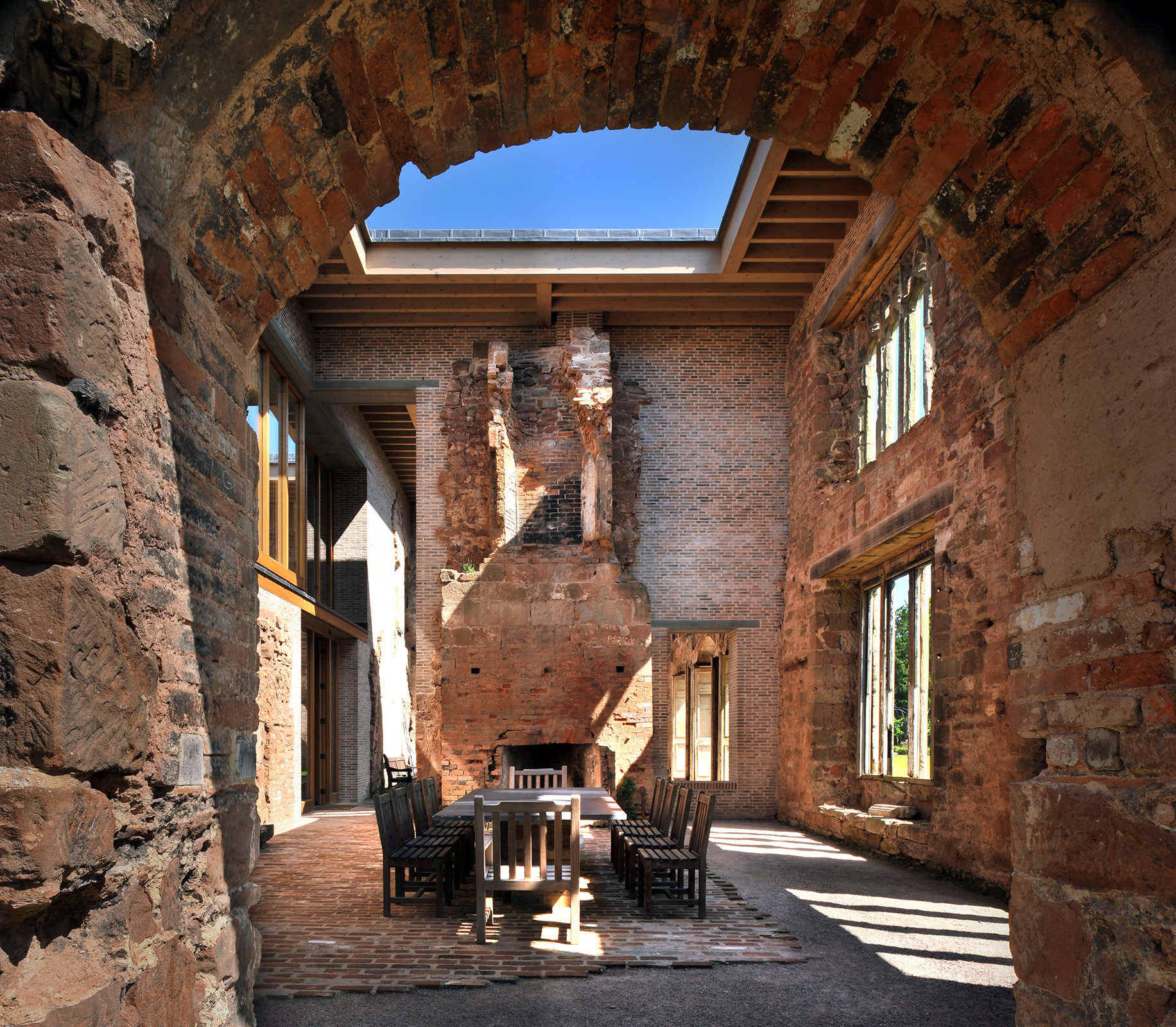
I first encountered the work of Witherford Watson Mann while living in east London, regularly passing their Amnesty International building in Shoreditch. The project comprises a sensitive adaptation of two old furniture factories, including a distinctive street level extension. A considered composition of deep brickwork reveals, lintels, cills, and hardwood windows, the project previewed the rigour and craft that would later become synonymous with the practice’s work.
Shortly thereafter the practice deservedly won the 2013 Stirling Prize for their impressive restoration of Astley Castle. In 2025, the Appleby Blue Almshouse in Bermondsey would win Witherford Watson Mann their second Stirling Prize.
Over the last year Stephen Witherford has reflected on these two projects; the conditions that were encountered, the creative and technical processes involved, and the physical and social outcomes that have only become apparent since the buildings have been lived in. This forms the basis of his lecture titled ‘The Heart of the Matter’, the first of the AAI’s lecture series on Social Inclusivity In Architecture. The lecture seeks to explore the symmetry of the practice's two Stirling-Prize-winning projects, 12 years apart, which on face value have little in common. Astley Castle, a medieval ruin transformed into holiday accommodation, and Appleby Blue, an almshouse serving sixty-five older residents in Southwark, London.
Witherford first draws comparisons with the ‘precarity’ of both situations. Both are born from loss of purpose, care and sense of self. In 1976 a fire ravaged Astley Castle and significant decay in the subsequent decades threatened the monument with imminent collapse. In the context of the almshouse, a crisis in social housing and epidemic levels of loneliness amongst the elderly is considered an erosion of humanity.
Witherford dives into the origins of the Astley Castle project, initially they were one of 12 architects to take part in a competition launched by the Landmark Trust to create a holiday house from the ruins of the medieval Astley Castle. However, according to Witherford, only 4 of the 12 submissions proposed to interface directly with the existing structure. The other entrants designed houses away from the existing structure to look upon the preserved romantic ruin.
The art historian Christopher Woodward argued that because the ruin is inherently incomplete, each spectator is ‘forced to supply the missing pieces from his or her own imagination’ [1]. In describing their initial approach, Witherford presents an early sketch articulating the profile of the existing structure’s broken remnants and a new light / thin structure connecting to the mass of the ruin. This ‘skinny’ structure would eventually be superseded by the decision to use thick masonry wall construction, mirroring and complementing the existing structure rather than sitting in contrast. The new structure is suspended by the old and the old tied together by the new, as Witherford puts it ‘both holding on for dear life’.
Analysing the dates of the different parts of the buildings fabric the project team were able to trace successive additions and alterations over the centuries. Since its establishment in C10th, Astley Castle has grown in increments of what Witherford describes as ‘masonry cells’. In order to draw together the disparate sections of broken fabric from various centuries, the office made a large cast model which became the testing ground for over one hundred iterative design judgments. Adding to this flux was the existing structure, parts of which were collapsing as the works progressed. The design was developed and amended to these ever changing parameters. Contentiously, they chose to retain the scars of the castle’s traumatic past, the initial encounter with the building for a visitor being through a large ‘rupture’ preserved in the ruin.
The accommodation required for the holiday home would only partially inhabit the ruin, occupying the western wall, the earliest form of construction in the building’s history. The other half of the ruin is outdoor space, a shared hall or vast outdoor room for socialising. In this courtyard the remnants of a vast masonry fireplace sits centrally, an important space throughout the history of the building. The space is flanked by stone mullions bringing light through the courtyard and into the rooms. Witherford describes these spaces as ‘being immersed in the presence of time’.
The decision to build into and on top of the existing walls became the catalyst for a deep exploration into tectonics and detailing. New lime mortar and brick diaphragm walls, filled with displaced material from the site, are the full depth of the original medieval walls and knit together the fragments of the ruin. Built from compatible materials so the new walls would expand, contract and move in tandem with the old, a slim Petersen brick was chosen in quarter lap bond to better tie into and emphasise the broken edges. No special bricks were ordered as a time and cost saving measure, instead the architects employed creative detailing, such as corbelled and staggered splays, to join and make connections. Vast concrete lintels bridge and bind new and existing fabric, and emphasise the vast depth of the walls. The detailing is rigorous, with craft and nuance on display; this is what Kenneth Frampton would describe as the ‘poetics of construction’ [2].
Moving onto Appleby Blue, a modern reinvention of the Almshouse typology designed for the United St Saviour’s Charity (UStSC) in Bermondsey, Witherford notes the most pressing issue was mitigating loneliness and avoiding displacement of the elderly residents from their community. The scheme completes an urban block of terraced Victorian workers housing, the site heavily bombed during WWII. The massing transitions from the scale of the main street, stepping down to the adjacent terraces.
In this instance, Witherford revisits the concept of cellular growth when considering the evolution of the Almshouse typology. The earliest forms of almshouses were large halls divided by timber partitions, later in the 15th century almshouses were defined by cellular homes arranged around quadrangles. This led WWM to propose a large outdoor courtyard, aimed to support the social lives of residents. The outdoor room would be surrounded by access galleries, influenced by the historic coach inns of nearby Borough High Street; the coach yard of the George Inn in particular matching the proposed geometry and scale.
The layout seeks to address the sense of isolation which is typical in older people’s housing by creating spaces that encourage socialising. The apartments surround the central courtyard, each level overlooks the courtyard space with glazed access decks, referred to as ‘interior streets’ these are light filled, warm and calm spaces which support social interactions.
The scheme meets the street with a glazed volume, Witherford considers the ‘rupture’ in this case to be the public entrance which connects to a double height garden room. It creates somewhere open and porous in the brick massing, and gives the Almshouse a civic presence.

The shared garden room is somewhere to foster unusual relationships and brings with it a connection to the wider community. This warm and dynamic space invites the neighbourhood to engage in a variety of activities, involving both young and old. Sitting between the interior courtyard and the high street, it links and transitions between the public activity of the street and the inner sanctuary of the garden.
Throughout the scheme spaces have been carved out for socialising and sharing, this is representative of a shift away from medicalised care to that of mutual support and dependence. The physical and mental health benefits are evidenced by the feedback from the residents, whose lives have been significantly improved by the quality of the spaces they inhabit. A productive roof garden provides food for a community kitchen on the ground floor. Witherford emphasises the importance of growing, making and sharing food in this environment. Creating a sense of purpose and community is key to the success of the project. As a result, the residents exist with dignity and pride.
It is rare that a lecture from a prominent architect focuses on so much on post-occupancy reviews, however, when the two projects share such glowing feedback from its end users, it’s easy to see why it is included. The visitor book of Astley Castle features compliments about the immersive experience and appreciation for a threatened monument given a new life. The residents of Appleby Blue movingly describe the improvement in the quality their lives, and most importantly a renewed sense of purpose.
Witherford describes both schemes as examples of working with the grain rather than against it and both projects are examples of this at differing scales. Astley Castle ties in directly to and takes heed of the existing fabric. Appleby Blue continues the grain at an urban level but also at a social level. The almshouse is an extension of the existing community, emphasising and improving what is already there rather than reimagining or reconstructing. There is an inherent sustainability in this approach, Witherford alludes to this at the end of the lecture. There are economies and efficiencies which can help with cost, constructability and embodied carbon, for example. Less tangible, but no less impactful, is the social benefit. In their post occupancy lives, both schemes have proven their social durability.
Paul Maher reviews ‘The Heart of the Matter’ a lecture by Stephen Witherford of Witherford Watson Mann Architects, part of the Architectural Association of Ireland’s ‘Social Inclusivity in Architecture’ lecture series. The lecture was held on 24 September in the Robert Emmet Theatre in the Arts Block, Trinity College Dublin.
Read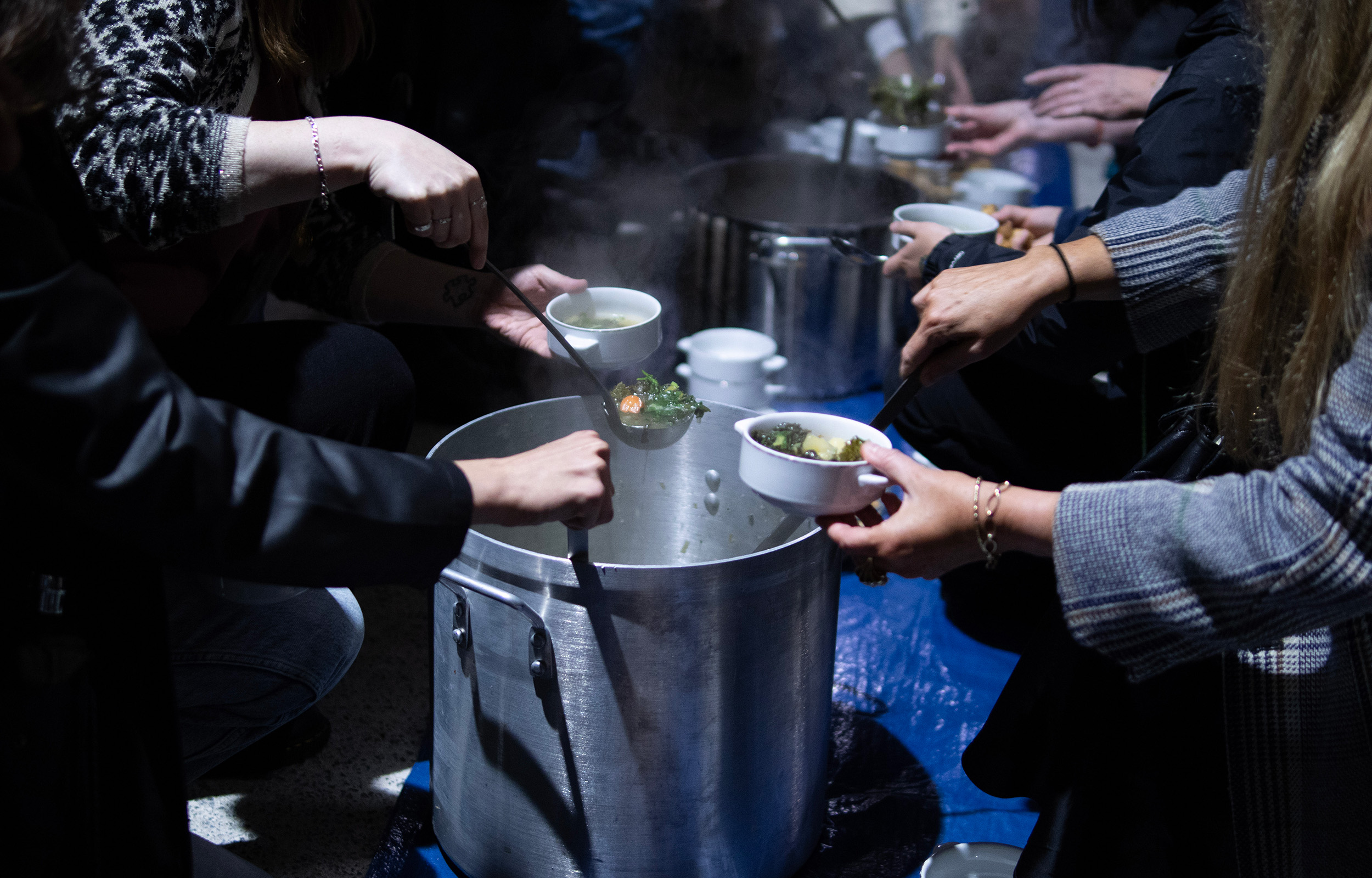
What does architecture have to do with food have to do with belonging? A lot, I guess? With a packed programme themed Le Chéile – the Architectures of Belonging, the changemakers behind this year’s Architecture on the Edge (AATE) seem to think so.
Nine years since its inception, there’s little doubt AATE belongs. What began as a weekend of Open Houses is now a ten-day festival and year-round initiative promoting responsibility and design excellence in the built environment. AATE reliably delivers fresh ways to engage audiences and explore architecture’s societal impact with each new iteration raising the bar. 2026 is no exception. The theme may feel a little familiar, but is suitably broad for the festival’s wide-angle approach and remains a vital topic for today’s fractured world.
Among the many food-adjacent offerings this year is settle: an installation by TRESTLE that plays stage to a talk by JP McMahon and a supper club from Guzzle. My choice is to attend the flagship Friday night offering, Pálás an Phobail (The People’s Palace): an immersive exploration of belonging told through food, sound, stories and space. This unique event is a collaboration between Zurich-based architect-polymath Blanka Major; Claire Davies and Enda McEvoy of social enterprise Hinterland and AATE Director Frank Monahan.
As part of the Swiss urbanism group ZAS*, Major’s hybrid portfolio breaks the ‘architecture bubble’ via site-specific, performative events. Galway-based organisation Hinterland, on the other hand, work at the intersection of food production, policy and community. Neither easily hemmed nor classified and with both motivated to redefine space for the public good, their collaboration promises an exciting mise-en-scène.
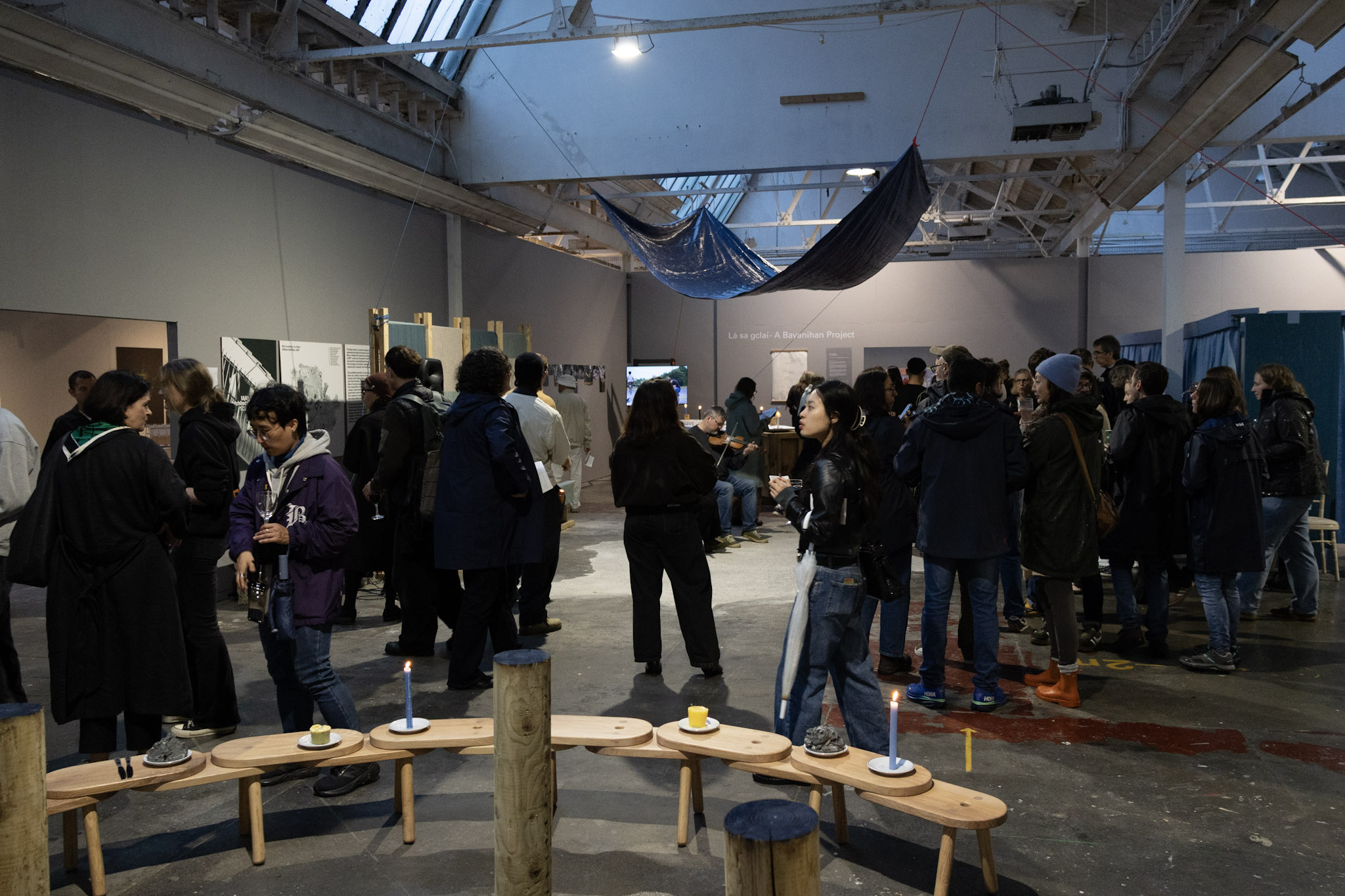
But it’s a tough brief. Pálás an Phobail must compete with hundreds of concurrent Culture Night Late offerings and be distinct from almost a decade of previous AATE programming. Held in the festival hub the Printworks Gallery on Market Street in Galway, even the venue does little to exclude comparisons. The space also home to exhibits including the potent Chloran Síle Flag by Miriam de Burca and Aine Phillips; Nocht Studio's interlocking KinStools and Ambacht Studio’s cyanotypes. Despite distractions; Pálás an Phobail holds its own.
The event conceptually pairs Galway’s beloved (and newly derelict) Pálás Cinema with the Maison du Peuple - Victor Horta’s art nouveau mansion commissioned as a multi-use civic space by the Belgian Workers Party. We are invited to imagine the Pálás an Phobail as a series of fictitious ‘rooms’: a market, a pub, a garden, a library, an assembly hall and swimming pool. As we move through, sampling indigenous flavours of Ireland, we will consider home-grown and imported ideas around food sharing and community infrastructure. With Hinterland’s Claire Davey in interview with Professor Anna Davies of Trinity College Dublin and Michael Higgins of Bohemians Cooperatives, the event is a hot ticket. You can’t get more accessible than free, but the audience seems in the know.
The location, next to Portershed a dó, is large, almost secret, and another example of a significant city-centre building fallen to disrepair. The floor inside is glinting with the day’s rain. My teen and I arrive dripping wet, grateful to be handed illustrated menus and heavy spoons and be ushered kindly towards a stall heaving with a dark, textural spread of Clew Bay oysters in blue spirulina on undulating and oily seaweed. We squint at sour lemon among bodies swaying to the sound of uileann pipes. Smiling faces. Hands clasping drinks. This is not your average night in Galway, granted, but it exudes a familiar warmth.
Further in, we are welcomed by our hosts and Davey asks pointedly: ‘who don’t we see here tonight?’
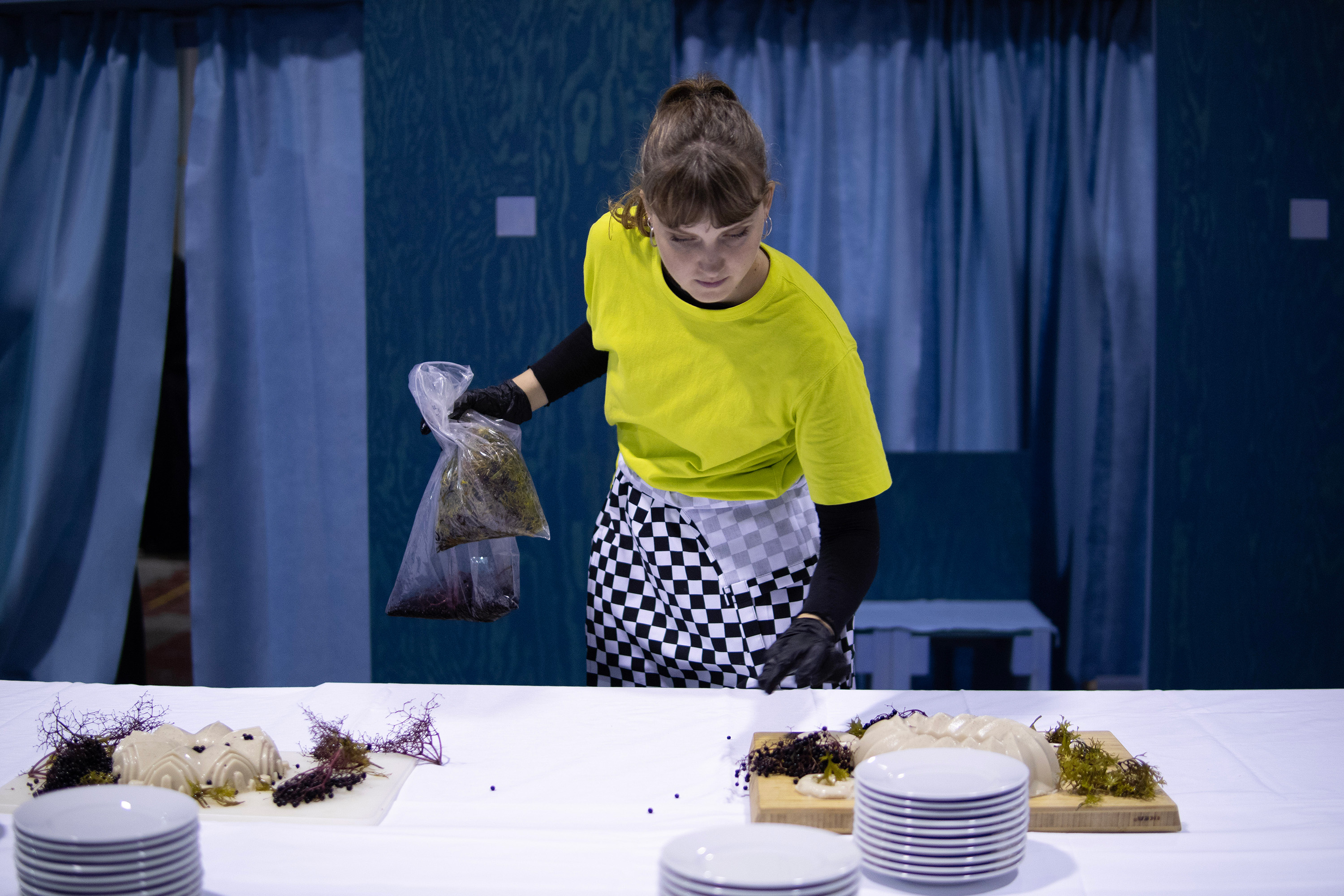
‘What if we had a shared food space, community owned and accessible to all?’ Major, then, dressed enigmatically in chequerboard whites and fluorescent yellow declares open ‘a space of possibility’. We begin ‘breaking the architecture’ - hammering windows of coloured sugar, making noises like nails beaten into walls. Sound is already a striking element.
Next? The pub. Guinness and cheese toastie wedges topped with beetroot remoulade. Devised by Major and delivered by Michelin-starred McEvoy the food is hearty, moreish, of the land. The menu asks us to consider taste inseparable from landscape, home or hearth: a carrier of ‘weather, labour, habits and memories.’ Anna Davies calls food sharing ‘a bedrock of human civilisation’ - a behaviour that endures globally, despite disinterest from Capital and neoliberal governments. When she talks of her struggles to secure funding, not for R&D but for implementing and maintaining the resulting ideas long term, I imagine tonight’s spectacle could easily precede same.
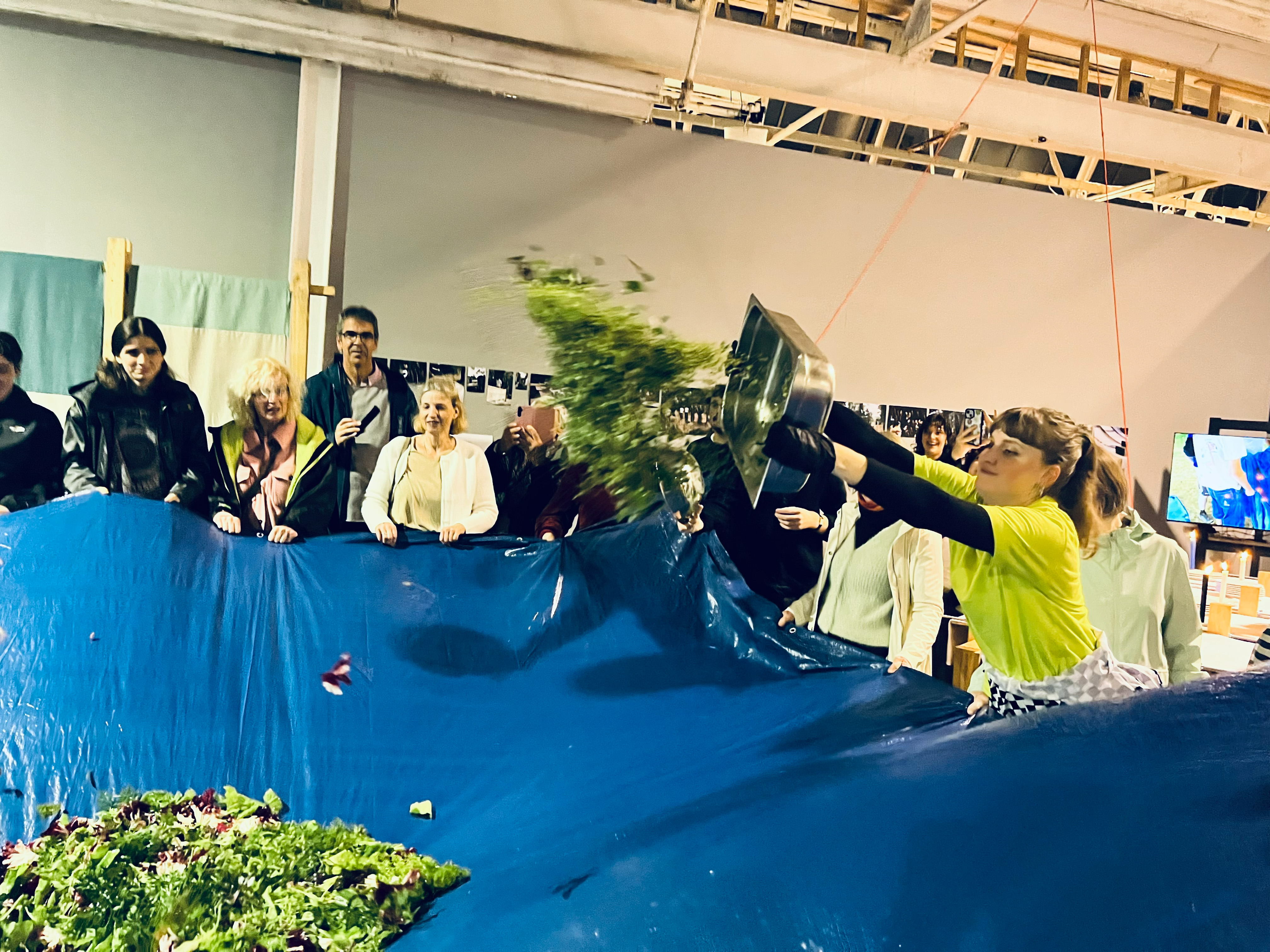
Looking up, a sheet of blue tarpaulin is being lowered to waist height. We grab and wave it as though playing the parachute game. Major and a parade of volunteers bring bowls of greens harvested from Fergal Anderson’s Leaf & Root Farm. We throw the salad onto the wind-strewn tarp, tossing it with collective energy. Major splashes on raspberry vinaigrette and spice from a popped balloon. This theatrical highlight an unexpected, joyous play inspired by Fluxus artist Alison Knowles. On hands and knees we scoop the unusual mix of potent stems, buds and leaves onto plates and into our mouths.
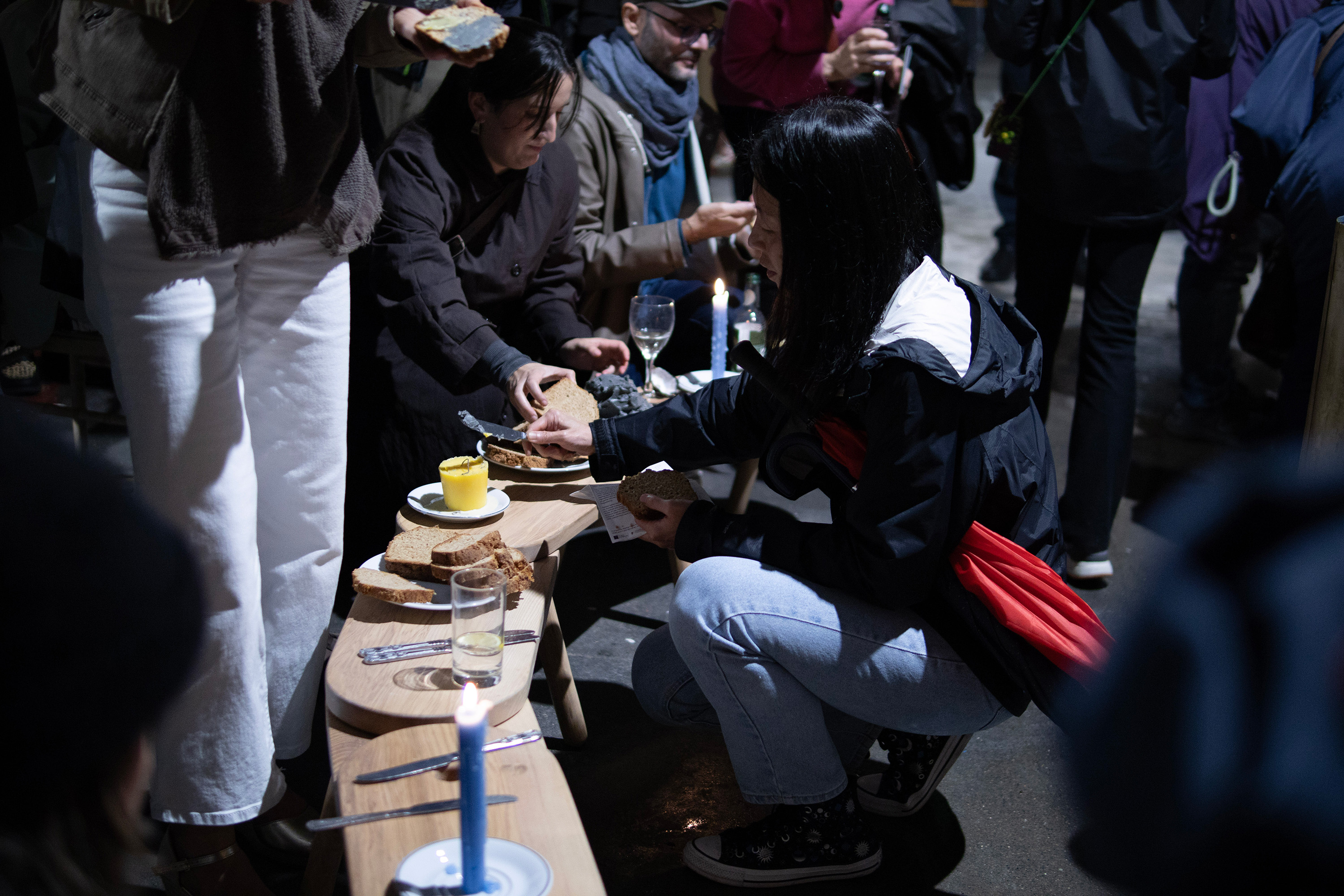
At this energetic peak, the night changes again. Crouched at KinStools lit by butter candles we slather slices of bread with putty-like charcoal butter. Michael Higgins invokes Plato’s Symposium – ‘I’ll talk to you after you’re fed’ – and social barriers are dissolved. We kneel, scooping potato and seaweed soup from deep vats and pass bowls around as friends.
It is a perfect illustration of the connecting, grounding power of food. The meal as a vehicle engineered to deliver big ideas. The pithy nature of the interviews that pepper the evening only adding emphasis to their pitch: we must build community wealth.
The final course is served at more of a distance. Moulded jellies of unctuous carrageen with jewel-like berries adorn a candlelit table. I peer in as they are photographed, pearlesque and shimmering behind blue pleated hospital curtains and ponder the banal separation between digital and real. My phone dies. The event has broken divides: diner and kitchen, organiser and audience. When plates are finally passed around, it ends with a flavour of sweet childhood nostalgia.
Which brings us back home to belonging, which is in a basic sense, synonymous with eating. Where else does one belong but with friends and family eating an heirloom milk pud? But this is just one layer. The underlying truth is, in an Ursula le Guin sense, that food is a carrier bag: a way to say things without saying them. Food can say: ‘I love you’ or it can say: ‘I am disempowered’. Food can be a means to navigate thorny issues of difference and entitlement, to communicate respectfully about socially charged issues such as ‘who belongs?’ Indeed, this complexity is part of what makes the subject beguiling. It is also, I imagine, a reason why AATE is making itself almost as much about eating. There is immense power in coming together for a meal, just as there is often a question over who is invited.
For one night only, Pálás an Phobail proved that what might appear an obscure, high-concept premise can be both accessible and vastly enjoyable. It was an embodied experience to engage the senses, emotions and intellect, even as it asked more questions than it could answer. Among those, a puzzle: who wanted to come but couldn’t? Who needed to come but wouldn’t?
‘Pálás an Phobail - tasting a sense of place’, is part of the Culture Night Late programme, funded by the Arts Council and the Department of Culture, Communications and Sport under the Night-Time Economy programme with support from Galway City Council Arts Office.
Chloë King reviews ‘Pálás an Phobail’, an immersive event curated by Blanka Major, a collaboration by Architecture at the Edge in partnership with Hinterland. The event was held as part of Culture Night Late in Galway City on 18th September and featured contributions from Professor Anna Davies of Trinity College Dublin and Michael Higgins, Political Liaison and Systems Change Lead at Bohemians cooperatives.
Read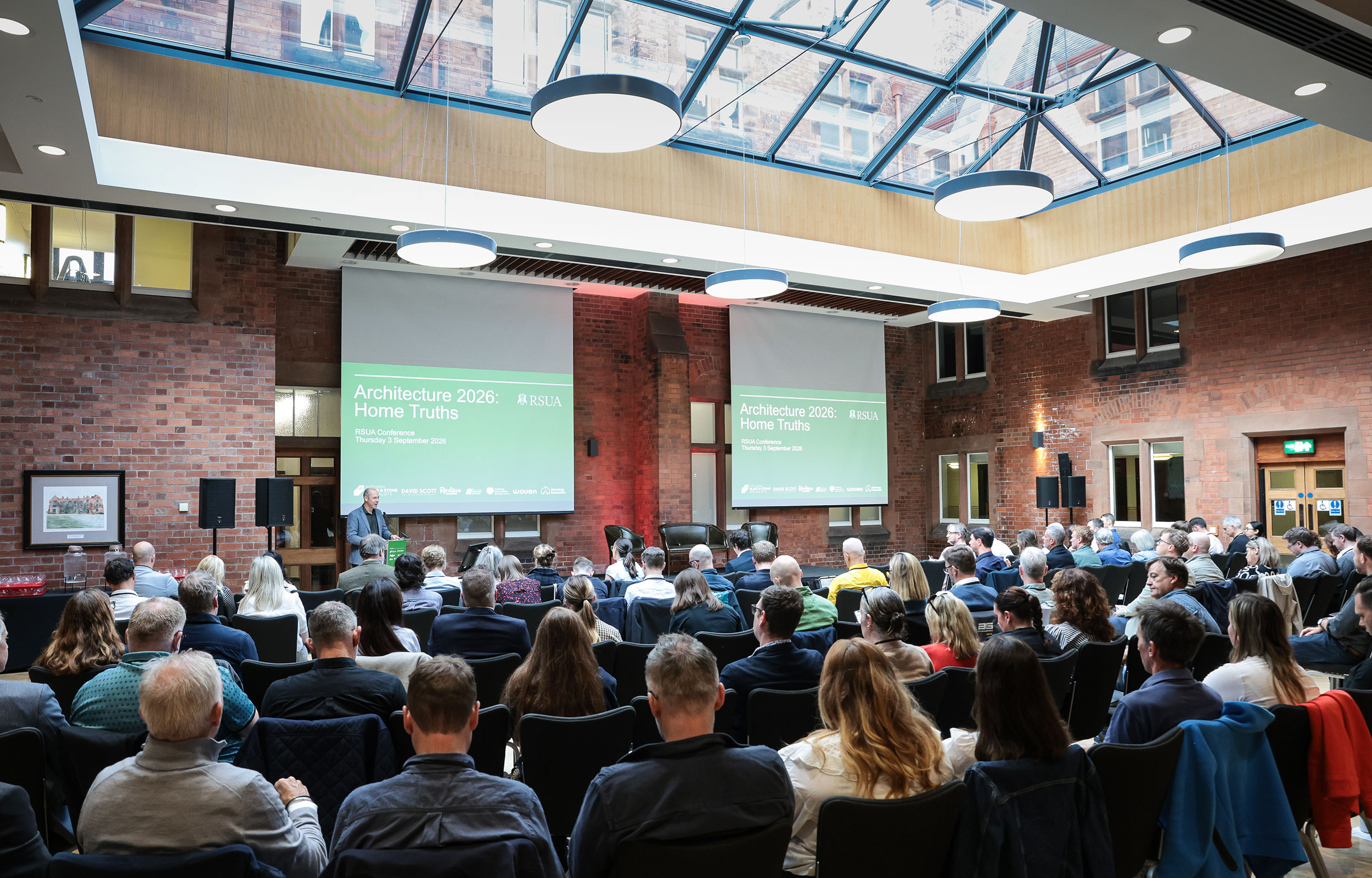
The newly renovated Riddel Hall situated on the campus of Queen’s University Belfast was the host of the second annual Royal Society of Ulster Architects (RSUA) conference, which was aptly named Architecture 2026: Home Truths. As the title suggests, the series of lectures and panels attempted to take stock of current housing design trends while also taking a chance to project more broadly into the future of housing provision.
The event was split into three sections, each with one or more lectures spanning varying scales of housing, followed by a panel discussion chaired by RSUA Director Ciarán Fox. Seven guests spoke across the day, with chances for informal dialogue scattered throughout. Although the conference acts as a diagnostic for construction across Ulster, what was immediately apparent was the international character of the invited guests. So although the conference provides some opportunity for conventional architecture exhibition, the visitors bring a sort of exotica to the discourse, acting as a catalyst against local stagnation.
Quoting T.S. Elliot, RSUA President James Grieve stated that ‘Home is where one starts from’[1], and indeed so too this event began with the motif of the rural house/home, and its entrenchment within the Irish rustic ideal. Eilidh Izat (Izat Arundell) and Roisin McCann (Marshall McCann) both presented examples of one-off rural homes, with the former presenting a case for locality and craft being the primary driver for highly contextual design. Focusing on the construction of her own home, Izat mapped the almost totalising extent which the island itself, the Isle of Harris, provided for the build: from the Lewisian gneiss stone which was quarried 5 miles from the site, to the construction team made up of entirely family or local builders. Izat’s presentation was ultimately an expression of local craft in home building, but projecting further, it provided a case for how subtle reference to surrounding regional building peculiarities could pave way for a new vernacular, one without pastiche or nostalgia.
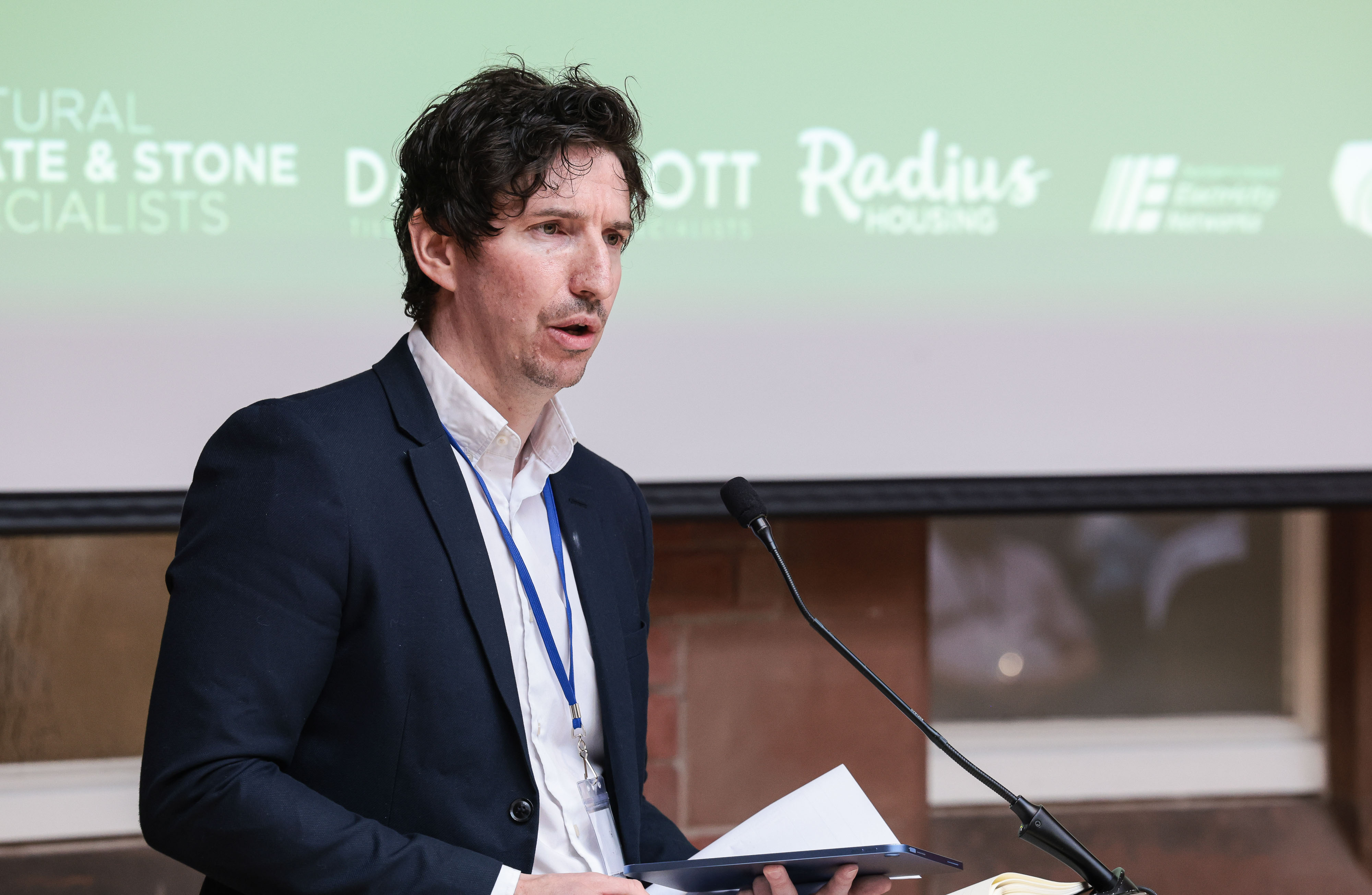
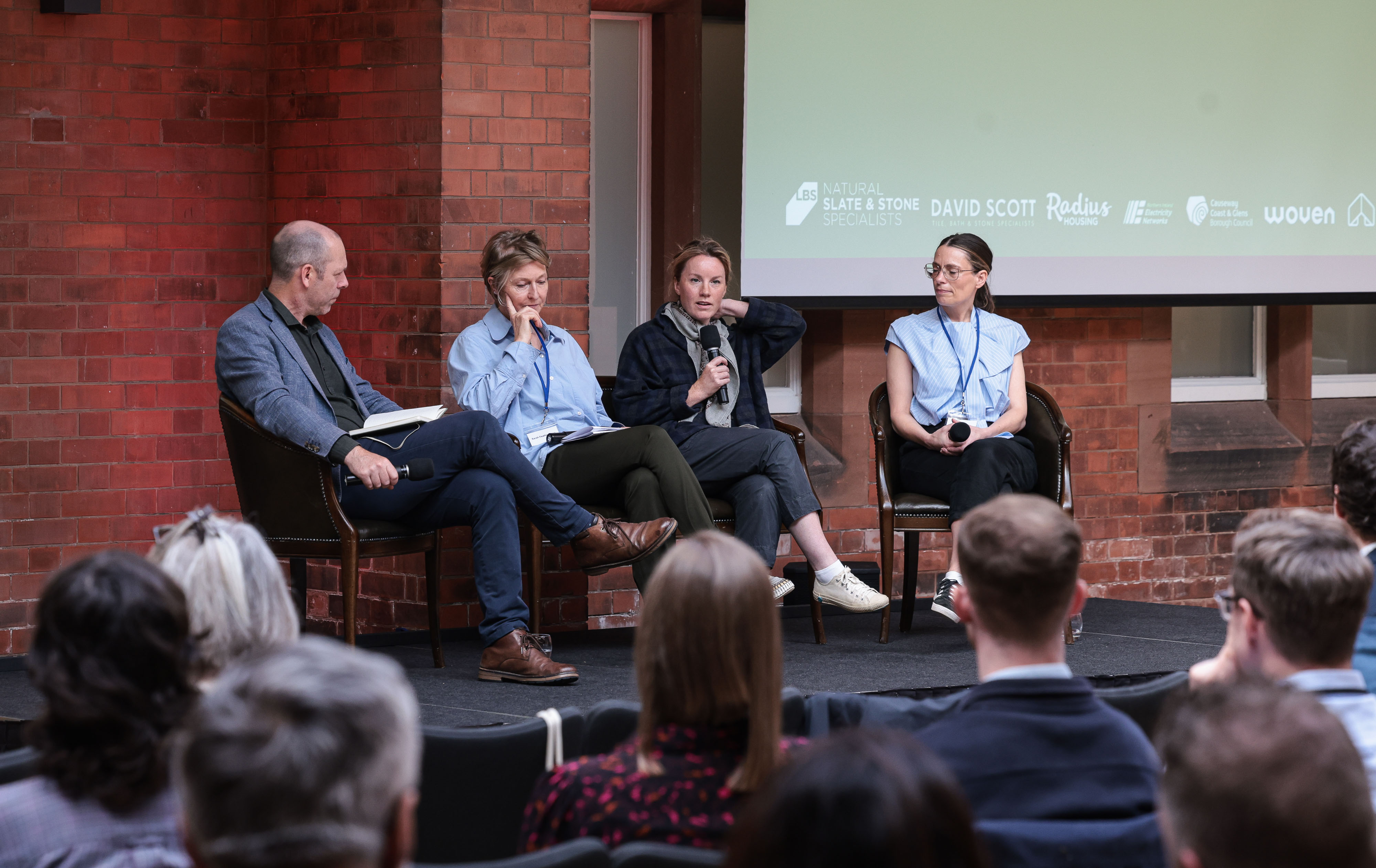
Mid-morning brought forth a shift in scale and spotlight, to one in which architects are often indifferent to, if not slightly ambivalent: the provision and procurement of housing. Speakers Siobhan Porter (Apex Housing) and Claire Bennie (Municipal) highlighted the many actors who, although often disparaged by architects, are crucial to engage when attempting to deliver housing of high quality. Both previously engaged in architecture directly, Porter and Bennie confidently argued that intelligent and robust design is the ultimate qualifier for successful housing developments and provided insight into how they attempt to champion this within their respective procurement bodies. However, Bennie also supplied a reality-check to architects in the audience, arguing that the profession is often let down by its ignorance (intentionally or not) to the importance of the building life beyond handover. In an industry rife with meticulously-curated portfolios and websites, Bennie positioned the lived experience of the built artefact and the community it fosters as the ultimate measure of accomplishment.
To conclude the conference, architect Oliver Schulze (Schulze+Grassov) provided his keynote lecture Home is not a housing unit or, as he changed it to on the day, Retain or Explain in reference to Denmark’s new construction idiom which is driving national planning policy. Initially presenting the sobering, but nevertheless damning, reality of the construction industry’s impact on our changing climate and pollution, Schulze summarised his involvement in the shaping of the Architectural Design Code pamphlet for the Danish city of Kolding, which can be used as a reference for the municipality when assessing future development in the city. Presenting the delivery of diverse streetscapes as the maxim, Schulze deemed that the architect’s role in urban design is to develop interfaces at the human scale, whether that be a permeable approach or otherwise. With this approach, the designer is forced to scrutinise the built fabric and make more intelligent extensions or transformations rather than any wholesale architectural gesture.
Although this discerning approach to design is something we have come to expect from our Northern European colleagues, inserting these principles on this land seems to be decisively more difficult. Schulze went on to discuss lessons learned from his involvement with the Belfast Waterfront before concluding with imagery of Belfast’s latest housing project: the North Street and Donegall Street Developments. The scheme aims to breathe life into a now neglected district of the city with the lofty promise of one thousand new homes interspersed around public realm development. Although Schulze praised Belfast for its existing modest network of pedestrian streets around the city centre, he commented somewhat solemnly on some of the obstacles that faced him and his colleagues in implementing a ‘street-centred’ approach into the city, due to the reality of statutory bureaucratic processes. However, despite the development’s previous 'cynical' iterations, Schulze did not hide his enthusiasm for the scheme, and so too his warmth towards the city as a whole.
The North Street and Donegall Street development is indicative of an inflection point in housing provision across the island. As the island’s population rockets towards its pre-famine levels, the Irish cities descend deeper and deeper into a housing crisis. So far the cities have responded through sprawl, often leaving valuable crumbs of vacated or dilapidated inner city housing stock on the table. With the absence of a cohesive design direction, speculative development has no issue with eating up ripe greenfield sites on the fringes of our urban centres, perhaps even believing this to be the solution. It is abundantly clear that the Irish cities must adopt an approach that incorporates higher densities, while infrastructures must deliver services to support them. But the old Irish dog may find it hard to learn new tricks, and the dog(ma) of building a home on one’s patch seems to be an inevitability, without meaningful challenge. This promise of one thousand homes in a city centre is this challenge on paper, but as discussed on the day, the proof lies in the developed artefact.
What Home Truths provided was an annual opportunity to debate housing and cities - the fly in the ointment of an otherwise affluent economy, both North and South. What remains to be seen is whether the learnings presented in these debates leads to tangible changes in approach, or whether we will wait until the conference swings around next year, to talk about something else entirely.
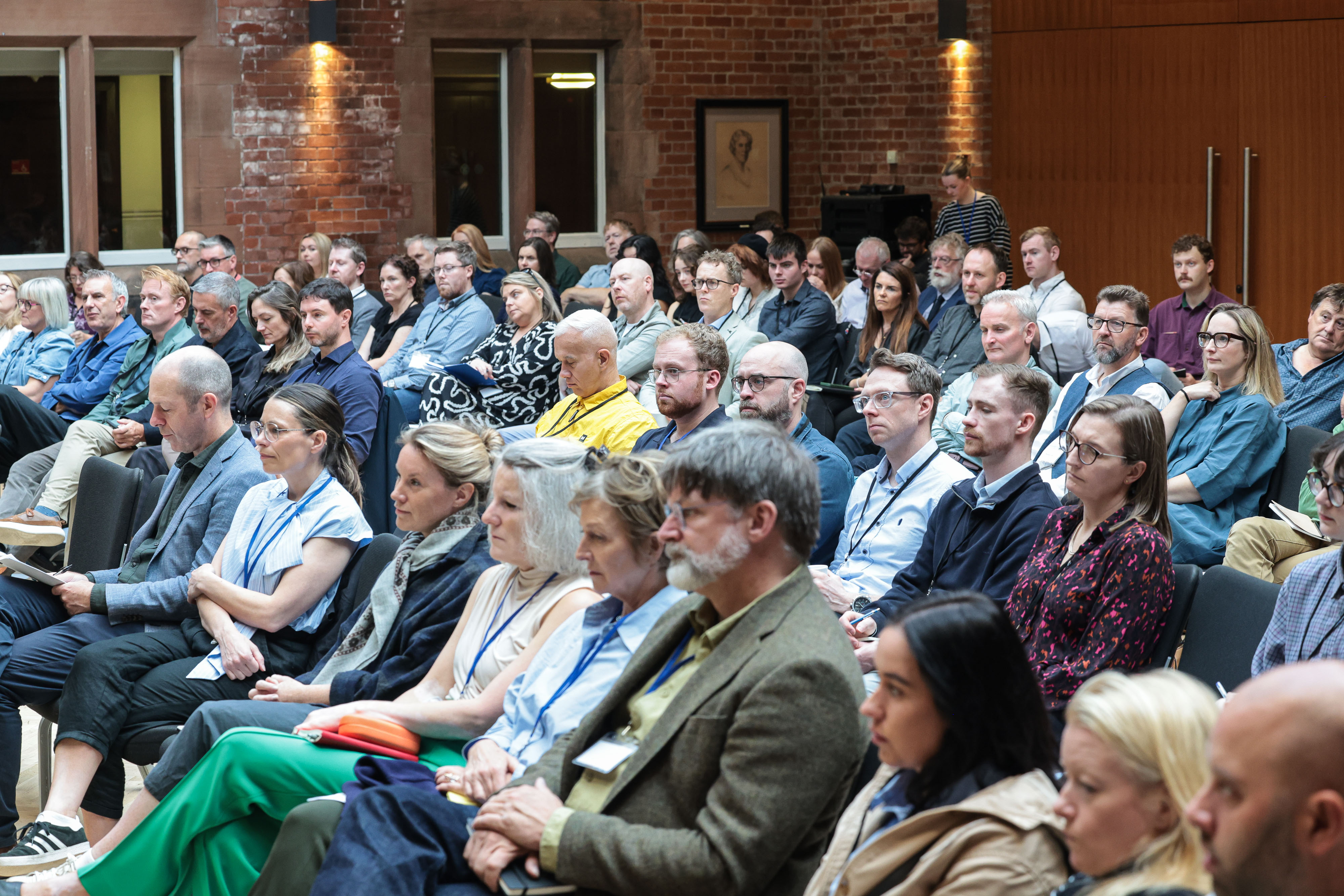
Ben Murray reviews ‘Architecture 2026: Home Truths’, the 2026 conference of the Royal Society of Ulster Architects. The conference was held at Queen’s University Belfast on 3 September 2026.
Read

Website by Good as Gold.