
Membership of Type allows unlimited access to our online library. Join to support new research and writing on the design of the built environment.
You can read more about membership here.
Already a member? Login to your account to avail of unlimited downloads.

Membership of Type allows unlimited access to our online library.
Join to support new research and writing on the design of the built environment.
You can read more about membership here.
Individual Membership Fees
Individual membership is available on a monthly or annual basis.
The fee is €10/month or €99/year.

Our current system of designing and making buildings has reached an unprecedented level of standardisation. Global networks of supply have dismantled historic approaches to making buildings, which were based on material availability, climate, and cultural practices. Throughout the world, architecture is now made from the same kit of parts, which is heavily reliant on four basic products: steel, concrete, glass, and plastic. Each contributes to the hyper-industrial world we inhabit, and together they represent what has been referred to as the Quadrivium Industrial Complex [1].
As industrialisation brought about the ubiquity of standardised materials at unprecedented speed and scale, regulatory frameworks [2] were designed around them, supported by aggressive lobbying and marketing campaigns [3]. Advertised as low-maintenance and technologically advanced, to mid-twentieth century Ireland these materials were symbols of a bright future in which cold, damp buildings subject to fire risk were things of the past [4].

Today, both the process of specification and the materials from which we build have become so entrenched that it can be difficult for many to imagine an architecture situated outside of the standardised system. Testing, certification, mortgages, and insurance policies in Ireland and beyond are generally designed around these systems. Natural materials with proven efficacy over centuries of service are often dismissed by the building industry due to their inherent irregularity, which can make them resistant to automation, and difficult to produce at scale. They are too often considered risky and fringe – a costly, niche option.
Architect and writer Keller Easterling has described the “single evil – single solution” outlook on architecture as “a fallacy, the truth is far worse” [5]. To make meaningful change in the construction industry, we need to accept that there is no simple solution to the problem of architecture, and that all construction practices cause harm, even if the full impact of a material’s extraction is not immediately visible. However, we instead continue to conduct the practice of architecture, or of architectural fabrication, as an exercise in problem-solving, to a series of standards established for predictable outcomes – a one-size-fits-all approach.

We are at risk of losing sight of architecture as an important mode of cultural production and further consolidating the monopolies that exists within the construction and development sector. To deliver cost-effective architecture that is of a particular place requires a granular understanding of local biodiversity, ecosystems, cultural specificities, and situated knowledge systems.
Architectural discourse is gradually recognising the need for a new direction. With a growing consciousness of both the enormous scale of our environmental impact, and the almost prohibitive cost of development, as an industry we are beginning to question not what we will build, but how we will do so: focusing on architecture as more than function or aesthetic, but rather as networks of resources, people, and ecologies.
The Irish Concrete Federation is evidently threatened by this, having recently updated their age-old slogan to an almost insistent “Concrete Built IS Better Built”. And in the face of growing pressure for change, the construction industry is seeking a silver bullet to enable it to carry on as normal. Hans Joachim Schellnhuber [6] has declared mass timber to be just that, stating that if construction over the next couple of centuries substitutes business‑as‑usual materials such as steel and concrete for engineered timber, the atmosphere could return to pre‑industrial conditions. However, we at Superposition believe that this understanding of material resourcing is misguided. No material can be sustainable if it is applied at a scale that is unsustainable, and we cannot reach carbon neutral construction within the boundaries of the current system.
There is great urgency here. If we estimate that a typical construction cycle spans seven years, then we have just four remaining cycles before 2050 in which to radically transform our construction practices. This is crucial to meet the ambitious targets established by the Paris Accords and to avoid severe environmental consequences. Although modular construction is often presented as the solution to seemingly global building crises, increased modularity will only result in increased homogeneity and reduced biodiversity. It is therefore deeply necessary for architects to engage with localities in a more specific and materially focused way.

While a shift to bio‑based materials is necessary, it is just as crucial to ask how these materials will be cultivated: where, on whose land, using what resources, and at what cost? While mass timber holds promise, there exists a cautionary tale around the pitfalls of monoculture plantation. In moving away from generalised solutions to the “problem of constructing architecture”, we must urgently work to establish a resilient and biodiverse construction industry, marked by concentrated pockets of knowledge that address conservation, sustainable cultivation practices, material usage, embodied knowledge, culture, and economy, and view each site’s distinct challenges as opportunities for innovative architectural solutions.
Superposition’s recent collaboration with Atelier LUMA, on the Unwanted/Overlooked Species Project [7], explored underutilised trees and plants native to the Camargue region of France, such as cypress and Aleppo pine, as well as invasive species such as the tree of heaven and cane de Provence. Our investigations focused on the highly resilient, heat-resistant Aleppo pine tree. Currently, due to the large number of branches and the conical shape of the trunk, over 80% of Aleppo pine trees harvested do not meet the current timber grading profile, and so fully virgin trees are burned for energy, or mulched.
In collaboration with the regional timber council, Fibois Sud Provence Côte d’Azur, and a local sawmill, we explored how Aleppo pine could become a viable source of construction timber. Taking reference from historic boat construction, which sought out, and often cultivated particular grain direction in trees to generate desired forms that were stronger and easier to work with, we designed a joinery system that embraced the complex and unique grain patterns of these timbers. The result is an adaptable framing system composed of just two elements – a node and a strut – in varying configurations and lengths.

Similarly, our project “An Experimental House” explores ideas for assembling and disassembling a structure with limited means within a particular context. The design is underpinned by digital design tools which allow for the rapid planning, transformation, and translation of the form. The first phase of the project was designed for easy assembly and disassembly within a gallery context. The second iteration of the structure elaborates and evolves the framework to explore ideas for grounding, sheltering, servicing, inhabiting, and maintaining, on the grounds of VISUAL Carlow.
Engaging with the material context within the region of a site, the project explores alternative uses for local, varied, and sustainable materials including native larch sections – a species compromised by climate change and the spread of disease – indigo, and beeswax from a local hive as a cladding material. These elements are held in place by the folded steel nodes which form the guiding logic for the arrangement of the structure. The structure utilises helical screw piles, and is designed to be disassembled, relocated, and inhabited upon completion of the exhibition.

Other recent projects from small and emerging Irish practices such as Fuinneamh Workshop Architects’ “Den Talamh” [8] and RAT Office’s “An Bothán Cladach” [9] seek to emphasise the use of natural, found, and irregular materials that embody the craft histories and material cultures of their sites and engage with both the challenges and opportunities of material scarcity and limited budgets. Further afield, students led by Kate Davies and Emmanuel Vercruysse at Hooke Park, the Architectural Association’s forest campus, have been exploring the construction of post-tensioned space frame structures and walkways which utilise found and pruned beechwood branches. The structures incorporate 3d scanning, CNC, and robotics in their design and making and propose an argument for the value of using near or on-site materials in spite of their inherently diverse characteristics. Together, these projects can be read as an increasing response to, and an attempt to practice outside of, the monolithic industrial architectural complex and its underlying thesis that humanity’s spatial demands can only be met through ubiquity and standardisation.
We see the future of sustainable design not as an exercise in the replacement of existing global networks with “green alternatives”, but rather in highly location-specific micro practices which respond intelligently to varying site constraints and climactic conditions and are flexible enough to integrate a wide range of materials while empowering local actors. This approach to architecture may not be scalable in the traditional sense, but rather utilises a particular framework or way of thinking which can be applied to a broad range of projects and regions. With contemporary technological advances, highly responsive and specific approaches to construction are not only essential, but entirely possible.

One Good Idea is supported by the Arts Council through the Arts Grant Funding Award 2025.
1. M. Jarzombek, “The Quadrivium Industrial Complex”, e-flux [website], 2019, https://www.e-flux.com/architecture/overgrowth/296508/the-quadrivium-industrial-complex/, (accessed 29 December 2024).
2. In 1933 the Cement Act was passed, providing the legal framework for the formation of a cement industry in Ireland. Irish Steel was established in 1939 as a private company. After the firm went into receivership in 1946, the Government purchased the company's assets and nationalised the industry until its closure in 2001. B. Roche, “Plant’s 62 years spanned boom and bust as economy evolved”, The Irish Times, 22 August 2005, https://www.irishtimes.com/news/plant-s-62-years-spanned-boom-and-bust-as-economy-evolved-1.482817, (accessed 29 December 2024).
3. The Irish Steel logo, used in the 1960s and 1970s, read, “Ní neart go cruach” – “No strength without steel”, while the Irish Concrete Federation declared “Concrete built is better built”.
4. Quantity surveyor Lisa O’Brien is the face of a new promotional campaign for Irish Concrete, underscoring all of its prior claims, and stating “the more concrete elements in your home the better!” Concrete Built [website], https://www.concretebuilt.ie/, (accessed 29 December 2024).
5. Keller Easterling speaking at the LINA Platform Conference Copenhagen, 10 October 2023.
6. Schellnhuber is a German atmospheric physicist, climatologist and founding director of the Potsdam Institute for Climate Impact Research. Formerly chair of the German Advisory Council on Global Change, Schellnhuber has been Director General of the International Institute for Applied Systems Analysis since 1 December 2023. “Hans Joachim Schellnhuber”, Wikipedia, [website], https://en.wikipedia.org/wiki/Hans_Joachim_Schellnhuber, (accessed 29 December 2024).
7. “Methodology”, Luma [website], https://www.luma.org/en/arles/atelierluma/methodology-atelier-luma.html, (accessed 29 December 2024).
8. “Den Talamh”, Fuinneamh Workshop [website], https://fuinneamh-workshop.com/project/den-talamh/, (accessed 16 December 2024).
9. “rat_office”, Instagram [website], https://www.instagram.com/rat_office/p/DA5S_KyuK1O/, (accessed 29 December 2024).
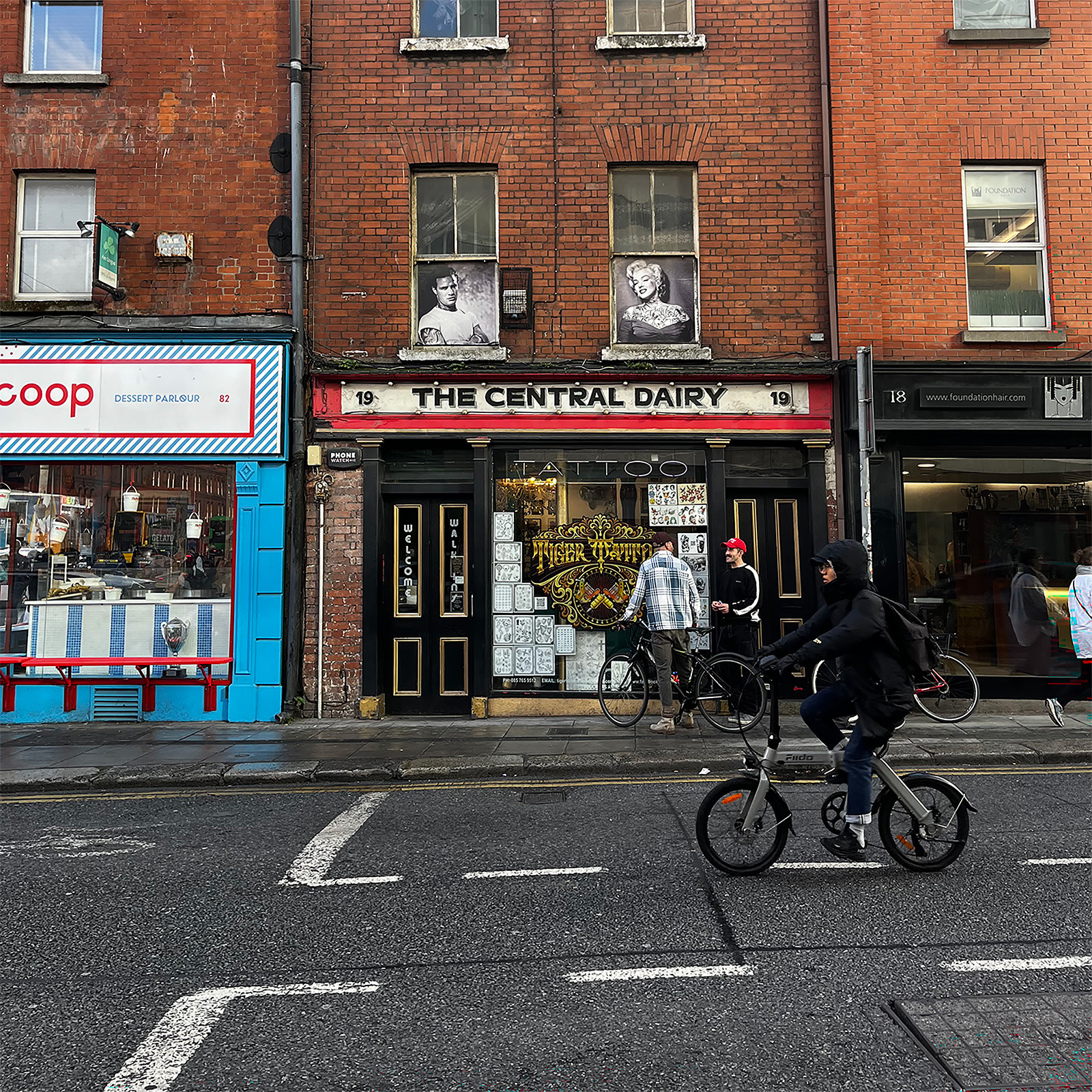
He watched her pour into the measure and thence into the jug rich white milk,not hers. Old shrunken paps. She poured again a measureful and a tilly. Old and secret she had entered from a morning world, maybe a messenger. She praised the goodness of the milk, pouring it out. Crouching by a patient cow at daybreak in the lush field, a witch on her toadstool, her wrinkled fingers quick at the squirting dugs.
James Joyce, Ulysses [1]
Joyce introduces Mrs Grogan, the dairy woman, in the first chapter of Ulysses. Milk is referred to over 300 times in his novel, with over 12,000 allusions: 18 times as brick, 200 times as water. Milk would have seemed material to the city in the novel’s setting of 1904. Did Joyce use milk as a symbol of something more than it has appeared in research to date? The agency of this substance was present in the first articles he published. When you look closely, it flows through his work and the streets of early twentieth-century Dublin.
1904 was the apex point of the female-driven dairies in the city. The clean milk movement and industrialised agricultural society were galvanising. Despite its relatively recent significance, the role milk played in the city would soon be effectively wiped from history.
Today, the dairy women, the ‘Mrs Grogans’ are gone; instead milk, a fluid, now arrives homogeneous, and neatly packaged in commercialised settings. Still, it remains popular, with Irish households consuming around 6.75 litres a week [2]. Ireland has a reputation for lower carbon in milk production and high-quality yields [3]. Our cows are raised outside on the land. The moisture-rich grass lends itself to both itchy sheep's wool and creamy, yellow butter.
Dr Jessica Smyth's research in UCD, which analysed residues in Irish Bronze age clay vessels, established there was clear early evidence of dairy rather than animal fats, and in larger proportions than elsewhere. This established that the Bronze-age Irish were already dairy farming and were keeping their animals for food production rather than just for meat. This culture began much earlier than anticipated [4]. Dairy has mapped out many key features of our diet and language. Bán Bia, the 'white food' influenced land usage, laws, the distinctive architectural characteristics of raths and burial mounds, byre dwellings. Early structures were designed to control or protect our animals from raiding and attack. Today the architecture of the barn and farming is omnipresent throughout the rural landscape. Its translation to domestic buildings would reinforce the opinion that it is a local, traditional, and arguably one of the few indigenous architectural forms of native post-modernism: the corrugated roofed barn has become an unlikely beacon of the new Irish aesthetic.
For the most part, we do not associate the fabric of Dublin with dairy. We do associate it with Ulysses, but not as an agent of the city, as a food or metaphor [5] so what was Joyce imbuing into Mrs Grogan?
In his book Ulysses and Us, Declan Kiberd tells us that Joyce's first stories were published in the agricultural journal The Irish Homestead in 1904 [6]. The journal, which was edited by the poet George Russelll, was referred by Joyce as the ‘Pig Paper’. Martina Plock relates to us that his stories were published within ‘a disagreeable vicinity of dietary and self-improvement pieces in the Irish Homestead’. Such pieces included ‘The importance of fraudulent butter‘, ‘Frozen milk and health’, and ‘Bacteria in the milk’ [7]. The Irish homestead was also an essential part of the promotion of the new cooperative and clean milk movement.
By 1904 milk was becoming an agent of patriarchy, modernism and capitalism. With the formation of the co-operative movement in 1874, the amalgamation of the small holdings was promoted as a means of fighting against the advance and commercial threat of Danish butter. Denmark had invented a steamer that was churning butter at a rate that was a severe threat to the Irish dairy market. This amalgamation impacted all the small dairies and milk producers in the city.
Joanna Bourke told us that milk was once evident throughout the city and county but the new cooperative creameries diverted dairy production from small-scale female-centric milk production spaces (including tenements) to large male-centric spaces, using new “scientific’ methodologies with distinct architecture identifying them [8].
The city is the locus of memory, its brick, stone and concrete hold a material account of the work of women's milk. This work could invite another mapping, this overlooked movement of dairy women carrying their milk cans. Like a stream of milk, the chain of production moving from the lush fields and out through the mechanisation of fast-approaching modernity.
Today we see more thought about the provenance of milk, people are asking questions about it in relation to climate and animal husbandry, the industrialisation of our food production has seen animals removed from the cities and this has had both a physical and social impact.
There is now a growing interest in micro farming and independent dairies with independent dairies popping up in Paris, Berlin, and New York [9]. There is a raw milk movement in our own country [10] It may now be of interest to reexamine the work of the dairy women and the flow of milk through both Ulysses and the city to see what was removed from the city when the chain of milk was interrupted.
Drawing from Ulysses is a fruitful and recognised form of criticism but extracting individual elements for study gives us sections through the city that may be relevant to its development. These reveal not only relationships between the city’s development but also the infrastructures of food, how patterns of food, land use, and gender constitute a locus of knowledge that has shaped the development of Dublin. A legacy that may be worth reviewing to align with modern urban and food ideologies.
A redrawing of the milky city of 1904 is long past its due date.
All Dubliners accept that the fair city is inseparable from James Joyce's Ulysses. Yet Joyce's novel is saturated with a hidden ingredient: milk. This industry is an essential part of our national image, but its relationship with the fabric and women of Dublin has been largely forgotten. What if we redrew Joyce’s Dublin through milk?
Read.jpg)
While teaching, Aldo van Eyck noted his architectural philosophy, explaining that ‘tree is leaf and leaf is tree – house is city and city is house’ [1]. At the core of this idea was the rich connection between the part and the whole, how each contains qualities of the other, creating somewhat of a symbiotic relationship between the two. Complex issues such as climate change or the decline of community spaces can feel broad and difficult to engage with, but by breaking these down into smaller, more accessible ideas, we can begin to understand how these things work and what collective action might look like.
In Mountbellew, a small rural town in Co. Galway, through the Design Lab Bursary programme, the Hidden Heritage Walled Garden project explored how a small intervention could begin a wider conversation about community space. The local walled garden is an often-forgotten amenity within the locality. This intervention centred around unlocking this space for the community, creating a wider discussion on its future. Through a collaboration with the local school, Holy Rosary College, we co-designed a new social gathering space where students created a structure on which to hold seating and planting. By unlocking the hidden heritage behind the six metre high limestone walls of Mountbellew Walled Garden, the structure would act as a catalyst for the garden’s long-term renovation, an initiative largely supported by the community.
.jpg)
.jpg)
The importance of the intervention was not simply the structure itself, more so in giving the community a physical way of thinking about a place that had become forgotten. Through the act of making something together, the students and in turn the wider community could begin to see the potential of this walled garden differently. Of course, the intervention does not solve the future of the walled garden or the decline of community spaces in rural towns, however it makes these questions tangible, giving them a place to be discussed. Through the creation of this singular space, it is hoped that the community realises its potential and begins to unlock further forgotten spaces on their doorstep.
Free Market, the Irish pavilion at the Venice Biennale Architettura 2018, highlighted the ‘generosity, humanity and possibilities’ [2] in the common spaces of Ireland’s market towns. It examined how the importance of these types of spaces has declined in recent years, exploring how they can be reclaimed once again, becoming integral places of interaction and community. One clear success of the Biennale project was its bringing of the conversation beyond the audience of the architectural community, travelling to towns across Ireland, gathering stories, ideas and people along the way. Through these individual discussions of a larger condition across the country, the part certainly became a way of understanding the whole.
In education, model making is a key element of our training as architects. Finding cost-effective and sustainable means of material sourcing can be challenging, and particularly relevant in a cost-of-living crisis twinned with a climate crisis. The re:model project at TU Dublin sought to address this at a small and physical scale, creating a system for the sharing and reuse of materials within the school. Through workshops of designing and making, students came together to create material-sharing cabinets. In making these units, meaningful conversations arose around promoting a circular economy and reducing waste within the broader context of the university.
On reflection, the re:model project was less about the cabinets created but more about creating a system within the school. Model making produces a large amount of waste, yet this is often an invisible part of our architectural education. Through the creation of a system of return and reuse, this project makes what was once a hidden system visible. Through confronting these bigger concerns at a smaller scale, the project translates an abstract environmental issue into an everyday action. Subsequently, a publication was produced, a how-to guide for making these units and implementing its system, shared across all design departments within the university. Indeed, the very system of return and reuse encourages responsible consumption for current and future students, but also, and maybe more importantly, it is through this small act of returning and reusing materials that students can begin to question their everyday habits of waste and their own designs, questioning the need and environmental impact of certain materials in their projects.
.jpeg)
.jpeg)
In both Mountbellew and TU Dublin, the act of making became a way of translating an otherwise abstract issue into something that could be seen and participated in. The power of projects like these lies not in their physical form, but in the larger ideas they make visible. The physical act of making opens up a discussion on the larger systems at play, helping us ask what could happen next? These interventions invite us to question, experiment and take risks, helping us discover new solutions and critiques of our current systems along the way. Like van Eyck’s tree and leaf, the small intervention contains something of the larger whole. Through community-led physical making, architecture can become a vehicle for conversation, bringing people together around issues that might otherwise feel distant.
.jpg)
Notes:
Mountbellew Walled Garden ‘Hidden Heritage’ project was carried out as part of the Architecture at the Edge Festival 2024 funded through the Design Lab Bursary by Galway Culture Company and the Arts Council, awarded to Brian Kelly and Grace Gacquin. Further collaboration on the project was carried out alongside LINA fellows, Dérive.
The ‘re:model’ project was carried out through student collaboration across multiple workshops, from design to construction. Supported by Laura Carroll and TU Dublin StuCAN (Student Climate Action Network). This project was developed through Green Campus Open Call 2025 and supported by TU Dublin Societal Engagement and the Higher Education Authority’s Strategic Alignment of Teaching and Learning Enhancement (SATLE) fund. Instagram: @tudublin_stucan
In this article, Brian Kelly proposes that architects prioritise community-led making as a means of translating complex issues into more tangible and accessible forms. Drawing on insights from two personal projects, he argues that change must be ‘made’ through time, passion, and conversation with others.
Read
In the first weeks of architecture school, I remember the exact moment the idea of ‘a building’ stopped being the point. Someone had pinned up a project and there was a plan and a section that looked almost standardised. Then the tutor, Dr Sarah Lappin, started talking through it: where the air would move, where water would go, what would fail first, how a single woman might feel in this space versus an elderly man, and what would cost more later if it was done cheaply now. The building on the wall did not feel like an object anymore, but felt like a set of choices that would land on other people’s lives [1]. Until then, I had assumed architecture was the finished building or the clean photograph. In that room it became obvious that the polished image is the last and least informative part, and that the real work is the ecosystem underneath it: constraints, trade-offs, and the consequences that fall out from them [2].
If you ask someone what an architect does, it’s the object that they usually describe – they see the hero photograph or the glossy image on socials. What they rarely see is the true medium of the profession: a long chain of decisions, made under constraint, where every move has consequences and every consequence has a constituency.
Tom Wujec’s ‘How to Make Toast’ exercise names the gap with disarming precision [3]. Ask most people to draw toast and they sketch a simple sequence: take bread from the bag, put it in the toaster, press the handle, butter, plate, eat. Ask someone trained in architecture and the drawing expands until the toaster no longer sits as an object on a counter, but as a node in a network: wheat and soil, labour and logistics, the power grid, packaging, waste, failure points. Toast stops being a standalone entity and becomes part of a vast system [4]. This is the professional superpower that architecture rarely admits in public – we are trained to visualise what other people cannot see. We do not draw objects alone, we draw relationships: heat, airflow, risk, access, time, cost, maintenance, politics – and in doing so, make the invisible visible. It’s also a friendly way into wicked problems [5]: the moment you draw the system, the task stops being linear and becomes an argument about priorities.

And yet, when architecture speaks to the public, it tends to speak in a single dialect [7]: the finished image. This is where the profession accidentally strengthens the narrative it claims to hate. If the public mostly encounters architecture as a final render, then ‘design’ looks like surface. It reads as aesthetic preference with optional flourish, the kind of thing that can be value-engineered away when budgets tighten. That is precisely the logic underpinning TD Seán Canney’s dismissal of ‘an architect’s ego going wild’ as the source of budget overruns in the run-up to last year’s revised National Development Plan [8]; design is reduced to image, indulgence, and unnecessary cost rather than understood as the thing that shapes how a project actually works. When political and media voices frame design as an impediment to progress – as expensive, slow, unpragmatic – the profession often retreats into technical language or internal reassurance. Architects talk to one another, roll their eyes, and leave the story to be written elsewhere. There is a communication failure here, where the profession keeps showing the toast and hiding the system.
Publish the thinking
There is a simple corrective to this failure, and it does not require a new software subscription or a public relations agency – it requires a shift in what is considered ‘the work’. Or, the decision to replace the hero render with a public diagram pack, and to treat that pack as participation infrastructure [9]. The point is not to simplify reality, but to communicate complexity legibly so that non-experts can participate in it [10]. Perhaps this participation could happen not via more finished images, but with a small, repeatable set of drawings that every project publishes early, updates openly, and revisits as the design evolves.
Five drawings are enough, if they are honest, and always published in the same order. They could look something like this:
(1) A Toast Map: what the project touches.
(2) A Risk Map: what harms it prevents.
(3) A Trade-off Receipt: what was chosen, what was sacrificed, and why.
(4) One Honest Section: how the project actually works.
(5) A Timeline of Consequences: who pays later if we cut corners now.
When it matters, add a sixth: the Public Redline, i.e., what changed after feedback, and why. ‘You said X; we changed Y,’ or, ‘we did not change it, and here is why’. Either approach makes the project more legible as a process. This is the point where objections and misinterpretation are not abstract risks, and a Trade-off Receipt can become a headline, a Risk Map can be read as an admission, or a Public Redline can be weaponised by actors who do not want the project at any cost, or by stakeholders who want a project quickly and cheaply and will use the drawings to shame any attempt at durability.
But the cost of hiding the thinking is not neutral, and when architects do not narrate the system, someone else will narrate it for them, usually as waste, delay, red tape, or taste. In that story, design becomes an indulgence and the public becomes a passive audience that could not possibly understand what is going on. However, in reality, the public is not an audience, but the stakeholder that lives inside the consequences. This is where the digital world becomes inevitable, and social media becomes the drawing language of that world, making futures visible before they exist: prototypes, promises, narratives. The app’s feed then functions like a public drawing set and quietly decides what counts as real.
A comment thread will not produce a perfect public, and will result in noise, conflict, and probably trolls. But treated with seriousness, it can surface the kind of local intelligence that formal processes routinely miss [11]: the wind that funnels down a street, the place that floods every winter, the doorway everyone avoids at night, the stair that becomes a barrier.

There is a reason, beyond reputation, that this inclusion is important: if architecture wants to defend its value beyond the profession, it cannot do so by simply insisting that design matters. We must demonstrate what design does: how it prevents harm, redistributes comfort, manages risk, and builds long-term value, not at the pretty ending, but at the beginning and in the messy middle, through a clear narrative of decisions. This is also how architecture can move into the mainstream agenda, as Phineas Harper has argued in different contexts: urban issues are political issues because they determine how people live [12]. These kinds of conversations should sit on Question Time, Newsnight, or Primetime.
Design is a shared attribute, and if people are to see the value in it, they need a stake in more than the finished image. They need a story that can be argued with, because if the profession keeps showing only the toast, we should not be surprised when people assume it simply pops out.
By presenting architecture only through slick final images, we undersell the true complexity and value of the profession, argues Dr Rebecca Jane McConnell.
Read

Website by Good as Gold.